Behind the Term Sheet: Embat’s €30M Series B
Stories
How this Madrid-born AI treasury platform closes the gap between financial intelligence and financial action
By: Jacky Abitbol, Romain Dufourcq, Colombe Moinet; Edits: Jaclyn Hartnett
Read on Medium
Treasury has become one of the most strategic functions in the modern CFO’s office. Rate volatility, cross-border complexity, FX exposure — the cost of managing these badly now shows up on the P&L. Yet most mid-market companies are still doing it in spreadsheets.
Consider this: more than a 1/3rd of companies manage treasury exposure manually. Why? Because the tools built to fix it were never designed for them. Enterprise software, enterprise timelines, enterprise pricing. The mid-market has been left to make do.
A new generation of treasury software is emerging that treats the gap differently. Not just broader access to the same dashboards, but a fundamental rethink of what the software does. The first wave showed CFOs where their money was. The next moves it.
Embat is that next generation.
At Cathay Innovation, we recently led Embat’s €30M Series B alongside Creandum, Samaipata, 4Founders, and Venture Friends because we believe that treasury is the final frontier of the CFO’s digital transformation. We see Embat as the infrastructure that allows companies to close the gap between financial intelligence and financial action. Here’s what got us invested.
A Large Market, Hiding in Plain Sight
The addressable market for mid-market treasury is larger than you think. These are companies in the €50–500M revenue range, managing multiple entities, bank accounts, subsidiaries, and currencies. From our analysis, this represents a $4B opportunity in Europe’s five largest markets alone, with 40–50% of that tier still unequipped and growing at 15% annually.
FIS, Kyriba, GTreasury — these platforms were built for Fortune 500 treasuries. Long implementations, expensive licensing, dedicated IT teams. A €150M business with five subsidiaries, seven banking relationships, and a three-person finance team cannot absorb that. So they make do with spreadsheets and banking portals, running enterprise-grade operations on infrastructure that was never designed for the job.
Several forces are now converging to change this:
–> API banking connectivity, accelerated by PSD2, makes real-time bank feeds possible at scale without SWIFT
–> AI maturity means reconciliation, forecasting, and pattern detection can be handled reliably without manual oversight
–> CFO stack modularisation is pushing companies away from monolithic ERPs toward specialised, interoperable systems — treasury is one of the last functions to make that transition
–>Demand pull from mid-market finance teams under sustained pressure from rate volatility and cross-border complexity
The result is a category in transition: from Systems of Record, built to report the past, to Systems of Action, where software executes on what it knows. That is the shift Embat is built for.
Enter Embat
Antonio Berga and Carlos Serrano started Embat because they lived the problem. As J.P. Morgan executives, they understood the intricate reality of global cash management from the inside out. They built accordingly. Joined by Tomás Gil, former CTO of Fintonic, their founding premise was simple: technology by financial experts, for financial experts.
Embat gives mid-market finance teams one platform to manage their entire treasury operation: cash visibility, forecasting, reconciliation, intercompany workflows, debt, and payments. It helps CFOs know where their cash is, forecast where it is going, and move it safely, without spreadsheets or fragmented banking portals.
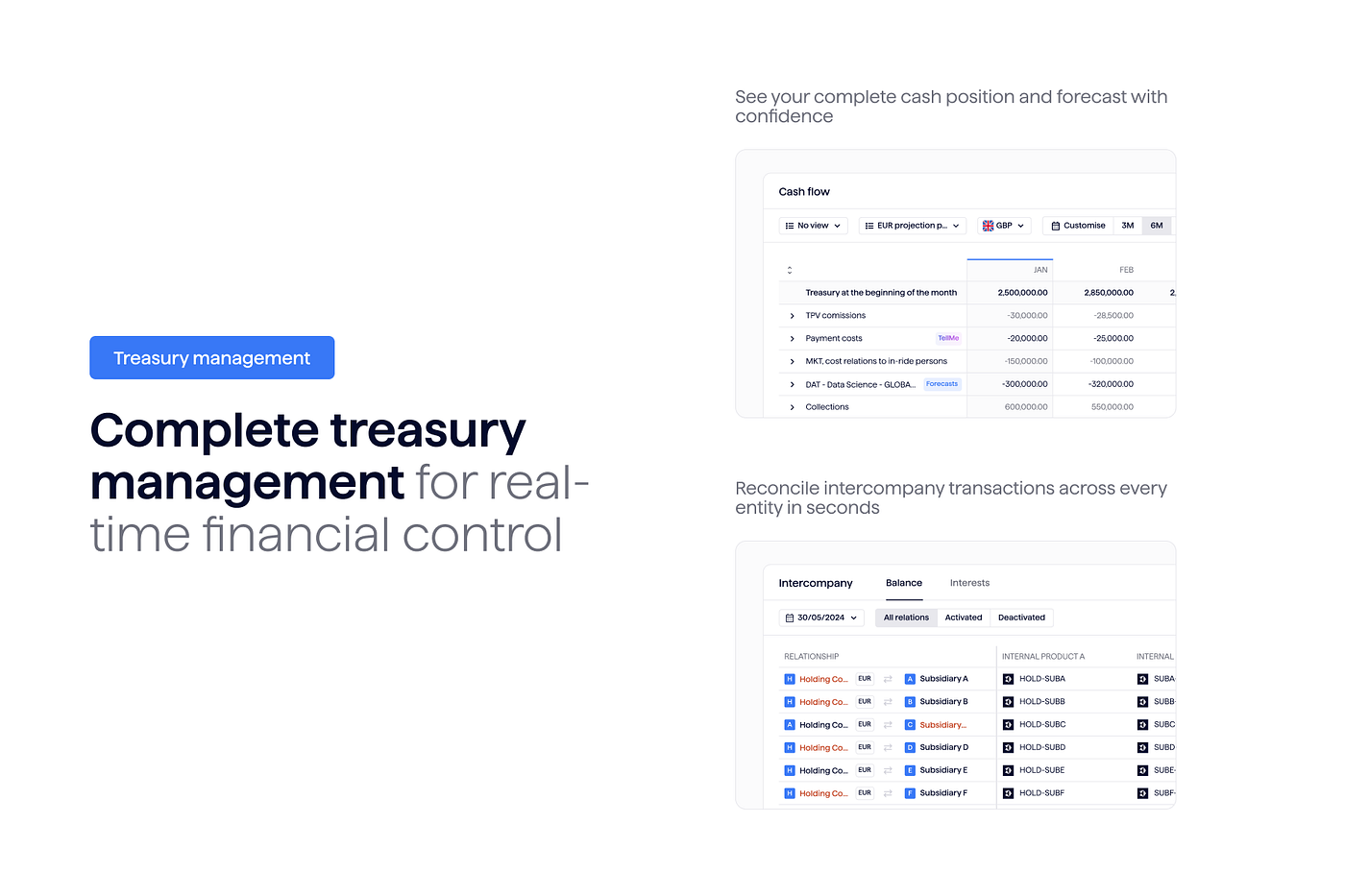
The platform connects to over 15,000 banks and integrates natively with Microsoft, NetSuite, SAP, and Sage. At the core of every module sits TellMe, Embat’s Agentic Treasury Analyst, which automates the last mile of treasury workflows: reconciliation, cash forecasting, data labelling, and payment execution, with the finance team in the loop throughout. With EmbatOne, Embat has extended into fintech territory, offering integrated payment execution across 15+ currencies and 30+ countries directly within the platform. The CFO acts on what the platform knows without switching systems.
Over 400 companies across Europe rely on Embat today, including Treatwell, Fever, PetLab Co., Watford FC, and Arena Racing Company. More than three quarters of those clients are traditional economy businesses — manufacturers, distributors, retailers — not tech companies. The adoption is happening exactly where the infrastructure gap is largest.
From Infrastructure to Agentic Treasury
Founded in 2021, Embat spent its first three years at the infrastructure layer building its strong full-stack software: bank connectivity, ERP integrations, reconciliation logic, and the data architecture that makes everything built on top reliable. The acquisition of Necto, a US-based corporate API connector, deepened that position further, adding proprietary direct connectivity to 35–40 major corporate banks. Clean, connected, owned data is what the AI layer runs on.
In 2022, alongside Google, Embat built one of the first generative AI applications in European financial services, applied to bank reconciliation and accounting automation. TellMe grew from that work. Because the underlying data is trustworthy, TellMe can automate up to 80% of manual treasury tasks and deliver cash flow forecast accuracy above 90%.
EmbatOne extends the platform from connectivity and data, through intelligence, to execution. Owning the workflow is the path to owning the transaction, and that opens a second commercial vector into the $500B global corporate payments market.
What’s Next?
Embat has cemented its position as the benchmark for treasury management in Spain. The Series B takes that playbook into new markets, with the UK and DACH regions as the primary targets. London and Berlin are already operational.
The focus for 2026 is twofold: scaling local teams in the UK and Germany to meet growing demand, and deepening product coverage across FX risk management, investment management, and debt management. The modules that move Embat from cash visibility into a full treasury operating system.
Spain proved the model. Europe is next.

Our Conviction
Embat sits squarely in our fintech portfolio alongside category (re)defining companies like Abacum (AI-native FP&A), Nelly (healthcare payments), and Range (AI wealth management).
For Embat (AI Treasury):
–> The market opportunity: clear.
–> The product-market fit: proven.
–> The team: expert-level across banking, tech and go-to-market.
But what convinced us to lead this round goes deeper.
Treasury is the last major function in the CFO stack to move from passive reporting to active execution. The conditions to make that shift are finally in place, and Embat is built for this moment.
The longer-term bet is that workflow ownership earns transaction ownership: a CFO who runs treasury through Embat doesn’t just manage cash better, they eventually move it, hedge it, and deploy it through the same platform. That moves Embat from software budgets into corporate banking economics.
We are proud to partner with Antonio, Carlos, Tomás, and the entire Embat team on this next chapter of scale across Europe. The modern CFO deserves better infrastructure. Embat is building it.
NEWS