Behind the Term Sheet: Midas’ $50M Series A
Stories
Opening a New Era for Traditional Finance: Bringing Financial Assets On-Chain from Europe
Words: Marguerite de Tavernost & Alban Vendeuvre; Edits: Jaclyn Hartnett
Read on Medium
If you’ve been following crypto, you’ve probably spent years waiting to see Wall Street move on-chain. That moment is no longer hypothetical: NYSE, NASDAQ, and Tier-1 financial institutions are now racing to embrace blockchain infrastructure.
The shift is underway. And from Europe, Midas is building the infrastructure layer underneath it. Last week, the company announced a $50M Series A, positioning itself as a core enabler of the transition from legacy financial rails to programmable, blockchain-based capital markets.
Here’s what got us invested — from Seed through Series A.
Tokenization: The Why & The Why Now?
Tokenization is one of the most significant shifts in financial infrastructure since the digitization of trading in the 1970s.
Euroclear, founded in 1968 in Brussels, was built to transition finance from paper-based systems to electronic settlement.
The next paradigm? A fully digital, on-chain financial system.

The convergence of blockchain technology, regulatory clarity (MiCA in Europe; the Clarity and GENIUS Acts in the U.S.), and institutional adoption is creating the conditions for a full rebuild of how assets are issued, traded, and owned. The window is open.
Here’s what traditional finance has been getting wrong:
–> Illiquid Markets, Locked Capital: In traditional finance, liquidity is structurally constrained. Subscribing to a private credit fund like Fasanara means waiting one to three months for redemption — capital locked up, earning nothing, while the underlying assets keep performing. Investors accept illiquidity as a cost of accessing yield. They shouldn’t have to.
–> Passive Assets, Idle Capital: A position in a private credit fund or structured product does exactly one thing: it earns its stated return. It can’t be used as collateral, pledged, or deployed elsewhere without exiting the position first. That friction is a feature of legacy infrastructure. On-chain, it disappears. Tokenized assets can plug directly into DeFi protocols, used as collateral in lending markets like Morpho to enable new strategies without unwinding the underlying exposure.
–> Institutional Gatekeeping: Most institutional-grade assets — hedge funds, private credit, structured products — are not available to retail investors. Minimums run to $100K or more. Accreditation requirements exclude the vast majority of people. On-chain infrastructure removes the distribution constraint: anyone with a wallet can participate.
Enter Midas.
Midas is a Berlin-based financial infrastructure company focusing on the tokenization of real-world assets (RWAs). Built to solve exactly these problems.
Operating at the intersection of traditional finance and blockchain, Midas enables institutions to issue, manage, and distribute tokenized assets — equities, funds, structured products — directly on-chain, under a fully compliant European regulatory framework. Each of the constraints above has a specific answer in what Midas has built.
Illiquid Markets, Locked Capital → Instant Liquidity; 24/7 Markets:
Through Midas, the redemption wait disappears. When investors mint a token like mfONE — representing exposure to the Fasanara private credit fund — they can redeem at any time. Private market exposure, public market liquidity.
Passive Assets, Idle Capital → Composability, Productive Capital:
Midas enables compliant DeFi composability for real-world assets — still unique in Europe —built on a bankruptcy-remote structure and a regulated securities framework within the EU. Midas recently launched an attestation engine that provides full visibility into the reserves backing each tokenized asset.
Institutional Gatekeeping → Democratized Access:
Via Midas, institutional-grade financial products are accessible directly from a browser, using stablecoins. This is the promise of internet-native investing: global, permissionless, and inclusive.
Early Conviction.
Our initial interest in Midas started top-down. We had been exploring the tokenization space for months, speaking with nearly every player in the US and Europe. The opportunity was clear: a new generation of financial infrastructure would emerge, similar to what Ondo Finance was building in the US. But Europe, with its evolving regulatory clarity, would need its own category leader, one with a regulatory edge that opened access to the secondary market.
When we first met Dennis (Co-founder & CEO), the fit between his background and vision was immediate. With experience across Goldman Sachs, Capital Group, and Greentrail, he had both the credibility and the technical fluency to bridge traditional finance and crypto. Paired with Fabrice Grinda — one of the most respected entrepreneur-investors operating across Europe and the US — the team had what it took.
Fully compliant with European securities and AML regulations, structured under German law, and built from day one with institutions in mind — it checked a critical, non-negotiable box: regulatory durability. Midas chose the harder path but, in our view, the more defensible one.
The company was pre-launch— fewer than 10 people, no product yet. For Ledger Cathay, that’s exactly where we like to invest.
We felt a rare alignment: the right market timing, the right regulatory setup, the right team, and an early enough stage to build something category-defining. Midas quickly appeared as the “pearl” we were looking for in the space.
When we invested at seed in early 2024, approximately $1.5 billion of RWAs were on-chain, largely concentrated in U.S. Treasuries and gold. The thesis was simple: a much broader set of assets would follow, and Europe needed a compliant, native player to bring them on-chain.
From Thesis to Execution.
Two years later, that thesis is not only playing out, it’s accelerating.
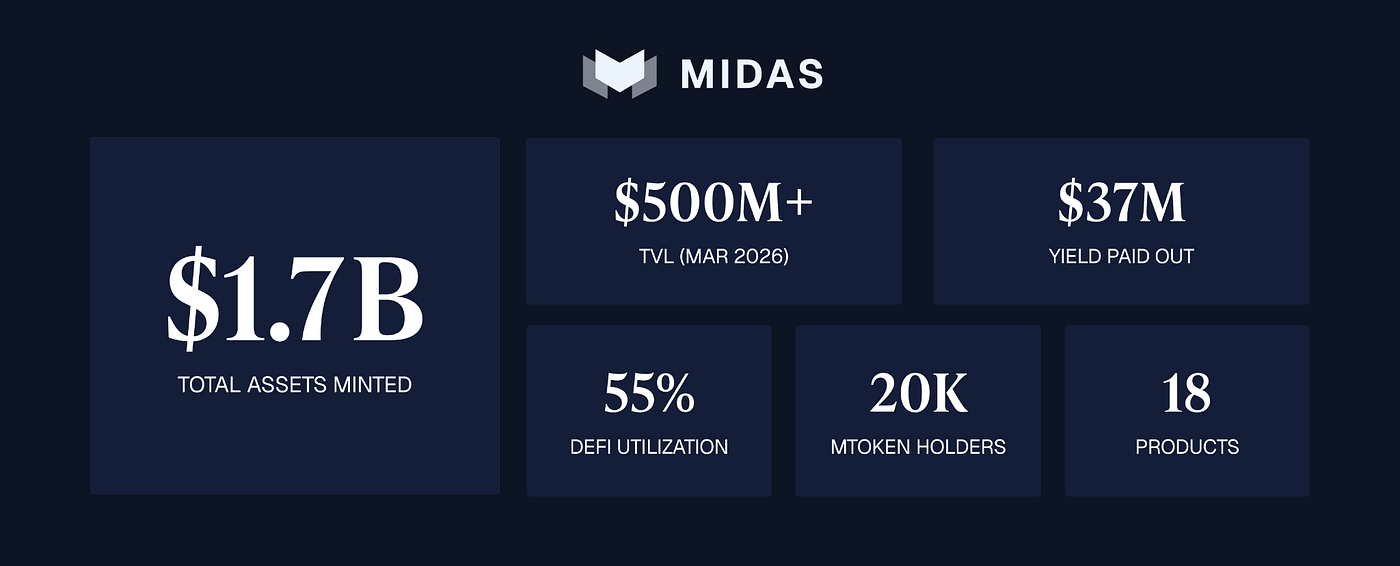
The market has grown to $23 billion in tokenized assets, spanning private credit, hedge funds, bonds, and equities. In 2025 alone, Midas facilitated nearly $2 billion in issuance with leading asset managers: private credit with Fasanara, hedge funds with Hyperithm, and T-bills with BlackRock.
But what impressed us most wasn’t the market growth, it was Midas’ outstanding execution.
In less than six months, Midas went from 0 to $1.7 billion in total value locked, with a team of just 12 people. That kind of velocity is rare.
Doubling Down.
Midas didn’t just grow, they found product-market fit.
The company has become a trusted partner for asset managers looking to bring strategies on-chain. Starting with U.S. Treasury Bills, they quickly expanded into private credit and hedge funds, working with some of the most renowned names in the industry. This is exactly the expansion we had underwritten at seed: from simple, liquid assets to more complex and higher-yielding strategies.
What gives us stronger conviction today is the emergence of a clear flywheel. New asset managers are launching new tokenized strategies → distributed across new channels → liquidity deepens through integrations with protocols like Morpho → which attracts more users and more issuers.
Infrastructure becomes a platform when that loop is self-reinforcing. That’s what we’re seeing.
What Comes Next.
Tokenized assets could represent trillions of dollars over the next decade. On-chain finance is not a niche. It’s becoming a foundational layer of global capital markets.
Access remains the key challenge — not only for Midas, but for the broader crypto ecosystem. If tokenized products are to reach beyond a narrow group of crypto whales, distribution must evolve. Fintechs, brokers, and wallets will all need to integrate on-chain infrastructure and Midas is positioning itself at the intersection of these emerging distribution channels.
Midas fits squarely within Ledger Cathay’s broader conviction around the transformation of financial infrastructure and the adoption of digital assets. We continue to invest in areas where technology is reshaping core financial systems, from payments and fintech platforms to blockchain-native markets.
The timing for Midas could not be better. As capital markets move on-chain, the infrastructure layer is the bet. Dennis and the Midas team are building it — and we’re backing them to win it.
NEWS