Behind the Term Sheet: Qualified Health’s $125M Series B
Stories
Building the trusted enterprise platform for health system AI
Words: Elijah Yi & Simon Wu; Edits: Jaclyn Hartnett
Read on Medium
Healthcare is deep into its AI moment, but it’s not without its cracks.
Over the last two years, we’ve watched an explosion of new tools come to market: scribes, prior auth automation, coding assistants, patient engagement copilots, revenue cycle tools, and more. For an industry that has long been labeled a technology laggard, the shift has been striking.
Health systems are no longer asking whether AI matters. They’re asking how to actually put it to work. That question matters because:
–> With the proliferation of AI point solutions, innovation can quickly fragment and
–> In healthcare, the answer to safe AI in production is far more nuanced than it seems..
This is what brought us to Qualified Health, building the trusted enterprise platform for health system AI. It helps health systems deploy, govern, and scale AI without becoming AI infrastructure companies themselves. Today, the company announced a massive $125M Series B. Here’s what got us invested.
First, Healthcare AI — Where are we now?
Administrative complexity alone still represents an enormous burden across the U.S. healthcare system. Many of the earliest AI point solutions have done a real service in proving that software can help.
But as adoption broadens, so does a new challenge: vendor sprawl. Each product comes with its own workflow, its own integration requirements, its own governance questions, and its own security review. What starts as innovation can quickly become fragmentation.
At the same time, building with AI is getting easier by the month. Models are improving. Development cycles are compressing. What once required a team of specialists can now be vibecoded in days. Despite the shifts, healthcare is not the market where fast to build automatically means that solutions are ready to deploy.
Production healthcare environments demand something different. They require deep integrations, auditability, governance, reliability, and trust. They require systems that can operate safely across clinical, operational, and administrative settings without creating new risk for already burdened organizations.
The bottleneck is shifting from building to operating safely in production.
Enter Qualified Health.
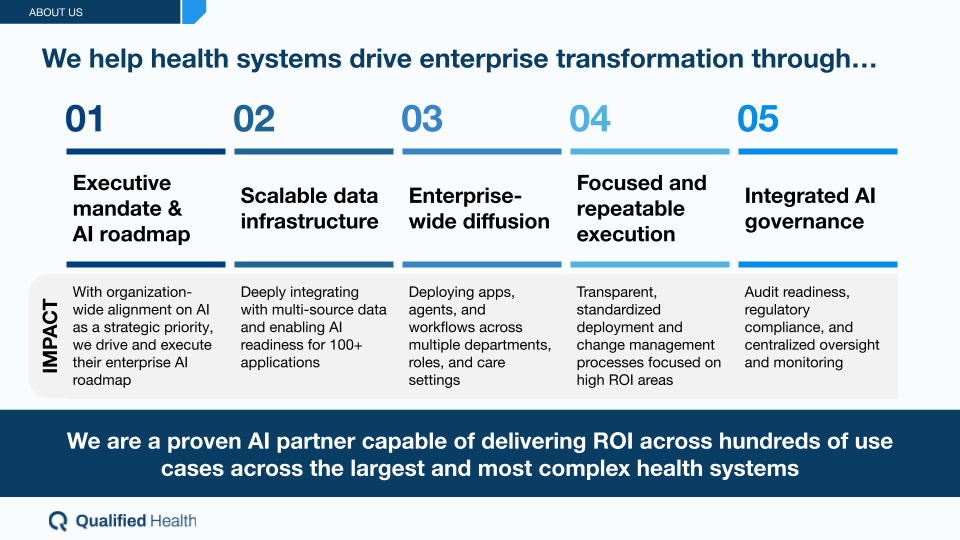
Qualified is building the trusted enterprise platform for AI deployment within health systems.
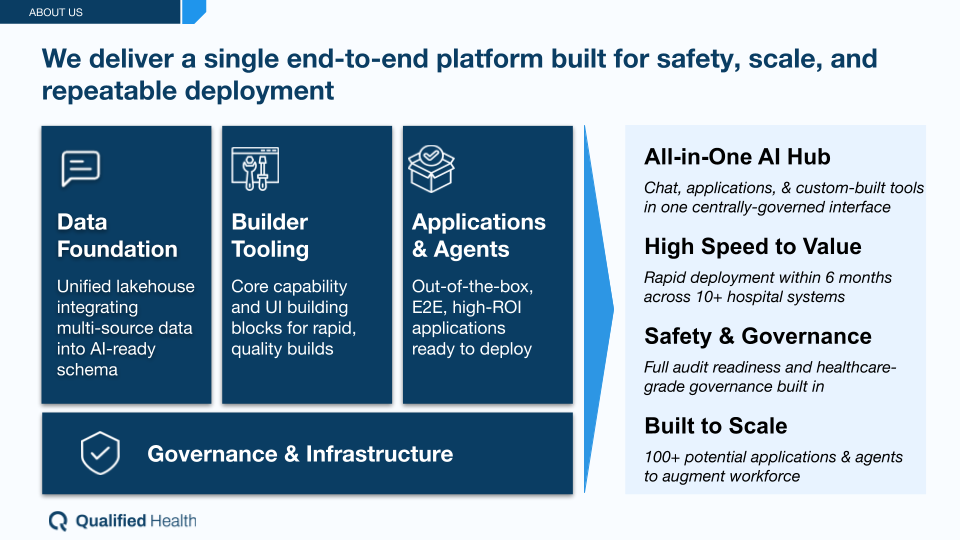
At its core, the company is helping health systems harness the latest advances in AI without asking them to become AI infrastructure companies themselves. The platform is designed to unify data across the enterprise, provide reusable builder tools, support workflow-level applications, and embed governance directly into the system rather than layering it on after the fact.
That architecture matters. In healthcare, there is a big difference between a clever demo and something an institution can trust.
Qualified’s platform is built around the idea that outputs need to be traceable, workflows need to be governed, and deployment needs to fit within the realities of health system operations. In other words, this is not AI for the sake of AI. It is enterprise infrastructure for turning AI into something usable.
Qualified emphasizes embedded access controls, audit logging, decision traceability, output validation, and exception handling as part of the platform’s core design.
Our Conviction.
The first wave of healthcare AI was about proving ROI one workflow at a time. The next wave will be about who can help health systems scale AI across the organization without accumulating operational debt. That requires a trusted partner; one that can sit at the intersection of model innovation, health system complexity, and enterprise accountability.
In this regard, Qualified stands out for several reasons:
THE TRACTION:
Qualified is already live with 15+ health systems — including Emory, University of Rochester Medicine, Jefferson, and all eight institutions of the University of Texas System — collectively caring for 40M+ patients and representing roughly 5% of all U.S. hospital revenue. At UT Medical Branch alone, the company delivered more than $15M in measurable run-rate impact within the first six months, across clinical, revenue cycle, and operational workflows.
That customer adoption is important not just because of who these institutions are, but because of what it signals. Health systems are choosing the company as a partner to help them deploy AI in environments where compliance, governance, and reliability are not optional.
THE TEAM:
We also believe that the people behind the platform matter immensely here, and trust compounds.
Healthcare AI is not a category where talent alone is enough. The winners will need both technical fluency and institutional trust. Justin Norden — former Stanford faculty, GSR Ventures partner, and CEO of TrustworthyAI (acquired by Google, deployed inside Waymo) — brings a rare combination of clinical experience, healthcare credibility, and AI systems depth. He is joined by co-founders Kedar Mate, former President and CEO of the Institute for Healthcare Improvement, Beau Norgeot, former Vice President of AI at Elevance Health and Shantanu Phatakwala, former executive at Haven, Evolent, and Resolution Health. Together they represent exactly the intersection this category demands.
When a health system decides who it trusts to help deploy AI across sensitive workflows, it is not simply choosing software. It is choosing a long-term operating partner. That is one of the reasons we think Qualified is so well positioned. The team has the domain fluency to understand where AI can create value, the technical ability to deliver, and the industry trust to get in the room with major decision-makers.
THE OUTLOOK:
What excites us even more is how this category should evolve from here. The underlying models will keep improving. Building blocks will keep getting cheaper and more capable. We believe Qualified will be riding the AI improvement curve which gets stronger as models improve, because they own the deployment layer, the workflow logic, the governance, and the trust.
Parting Thoughts.
Qualified Health reflects a broader truth about healthcare AI: the hardest part is no longer imagining what AI can do. It is earning the right to deploy it where it matters most.
We’re thrilled to partner with Qualified on that journey, alongside NEA, Transformation Capital, Greatpoint Ventures, and Anthropic through its Anthology fund, alongside existing investors including SignalFire, Frist Cressey Ventures, Flare Capital Partners, Healthier Capital, and Town Hall Ventures.SignalFire, Healthier Capital, Town Hall, Flare, and others. We’re excited to support Justin and the entire team as they help leading health systems move from AI experimentation to enterprise-wide transformation.
Want to help build the future operating system for healthcare? Qualified is hiring:
Jobs @ QualifiedHealth
NEWS